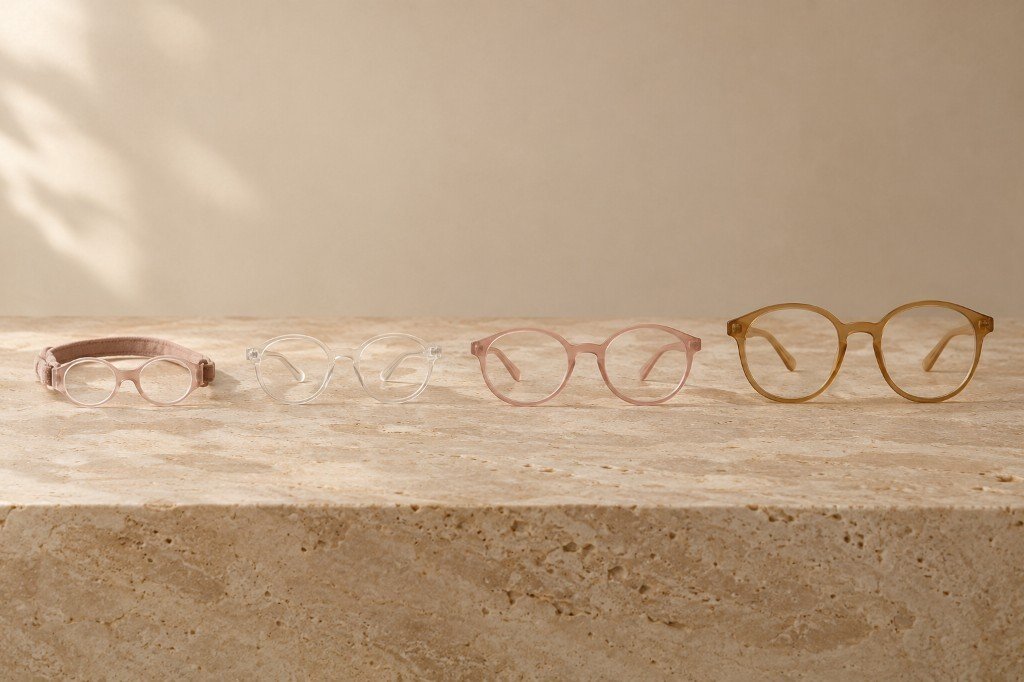
Baby glasses and a school-age frame should not stand on the same shelf. At 0–1 the head circumference and the root of the nose decide; the frame is often supported by a band, and the temple is not yet the main carrier. At 1–2 the temple comes into play. At 2–5 the face changes quickly, and the bridge and pad adjustment need frequent checks. Ages 6–9 are the range where the school bag, break time and dropping the glasses begin. At 9–12 and 10–13 the measurements approach an adult form; a scaled-down adult model still does not take the place of this range.
The Ninoflex collection is built on these bands. In the brand’s own series the age split is clear: baby models for 0–1, then 1–2, 2–5, 6–9, 9–12 and 10–13. Model codes can change with the season. The principle does not. Each band carries its own fit.
An age range is not a size chart. Two children of the same age can differ in temple width and nose height. The label narrows the search. The last word belongs to the fitting the optician makes on the face. If there is a prescription, the lens is cut to the optical centre of the frame; the trial lens and the prescription lens move in the same order.
A question families often ask is whether glasses worn at an early age will be uncomfortable. The wrong frame worn early is uncomfortable, and the child wants to take it off. A frame that sits correctly keeps the prescription from the examination in front of the gaze. The medical decision belongs to the eye doctor. Ninoflex’s work is to keep the frame on the face after that decision.
Across ages 0–13 there are more than 300 models and colours. The choice leaves colour until the end. First the band, then the fitting, then the adjustment.